Monday, August 4, 2014

A Change of Heart: The Candor of Heinrich Cornelius Agrippa


Anyone who has ever beheld a copy of De Occulta Philosophia Libri Tres (The Three Books of Occult Philosophy) by Heinrich Cornelius Agrippa — that infamous 16th Century German magician and alchemist — knows that it is a very lengthy tome. It is a sort of encyclopedia or compendium to all that was known at that time, at least to Agrippa, about occult magic, divination, astrology, and alchemy. He began work on the tome sometime in 1509 to 1510, and sent an early draft of it to his mentor, the great Johannes Trithemius — that other great German occultist and scholar. Agrippa was only twenty-four years old. The first book of the three was published in 1531, and the rest published two years later in 1533; just two years before his untimely death at the age of forty-seven. It is quite a lengthy tome, so needless to say I have not read the whole thing, though I do pick it up from time to time to peruse certain chapters and sections. Just recently I was reading the last few chapters — excerpts he added into The Three Books from a polemic of his on science of that time, entitled De Incertitudine et Vanitate Scientiarum atque Artium Declamatio Invectiva (Declamation Attacking the Uncertainty and Vanity of the Sciences and the Arts, published in 1526 — that I wish to discuss. In particular it is Agrippa's almost complete change of heart on magic, and his candor is something I find to be very admirable.

There is a quote that is often misattributed to John Maynard Keynes (actually I don't even know who said it originally), but I like it anyway and it is appropriate here: "When my information changes, I alter my conclusions."

Agrippa did just that: he worked on, revised, and published his canonical work, The Three Books of Occult Philosophy, and after nearly twenty years of working on it he rejected much of what he had written before. It is at the end of the final installation of his three books that Agrippa recants much of what he said:
"But of magic I wrote whilst I was very young three large books, which I called Of Occult Philosophy, in which what was then through the curiosity of my youth erroneous, I now being more advised, am willing to have retracted, by this recantation; I formerly spent much time and costs in these vanities. At last I grew so wise as to be able to dissuade others from this destruction.
"For whosoever do not in the truth, nor in the power of God, but in the deceits of devils, according to the operation of wicked spirits persume to divine and prophesy, and practising through magical vanities, exorcisms, incantations and other demonical works and deceits of idolatry, boasting of delusions, and phantasms, presently ceasing, brag that they can do miracles, I say all these shall with Jannes, and Jambres, and Simon Magus, be destined to torments of eternal fire."
De Occulta, Book III, Chapter IXV (originally from De Incertitude et Vanitate, Chapter XLVIII): Of Juggling or Legerdemain
Now, Agrippa did not reject magic in its entirety, but he does believe that a great number of magicians and sorcerers were frauds and charlatans: he came to call them "jugglers" and legerdemains (someone who is crafty and deceitful with their hands). Many of the great magicians he had so greatly admired throughout his life he had come to regard as frauds: Paseton, Numa Pompilius, Pythagoras (yes, the mathematicians, who was also a notable sorcerer), and even the Thrice Great Hermes Trismegistus. He regards all things they and others like them have done to be "according to appearances only":
"...these things which are supposed to be juggled or bewitched, besides imagination, have no truth of action or essence. The end of these is but to hold forth things to the imagination according to appearance, of which there presently remains no footsteps or signs. Now by what hath been said, it is manifest that magic is nothing else but a collection of idolatry, astrology, and superstitious medicines."
It is not apparently in the chapter Of Juggling or Legerdemain that Agrippa still accepts some forms of magic, but in a few preceding chapters this is abundantly clear. For the most part magic was superfluously flooded with superstition, and much of practical magic was either juggling or the work of devils and evil spirits. Cabala, that ancient study of Jewish mysticism, becomes a point of heavy attack by Agrippa, who seeing it as mostly a secretive oral tradition with no real practice or operation, claims it to be "a mere rhapsody of superstition... nothing else than a most pernicious superstition" (Of Cabalie).

Concerning geotia (black magic) and necromancy (literally divination and magic performed with the assistance of the spirits of the dead) Agrippa believed these to be real magic, but only by the assistance of evil spirits: "...it doth not yet appear that these arts are fables... and why do the geotians use those evil spirits only, but because good angels will hardly appear expecting the command of God, and come not but to men pure in heart, and holy in life: but the evil are easily called up, favouring him that is false and counterfeiting holiness are always ready to deceive with their craft, that they may be worshipped and adored" (Of Geotia and Necromancy) But concerning theurgia (white magic) Agrippa simply agrees with Porphyry: "...by theurgical consecrations the soul of man may be fitted to receive spirits, and angels, and to see God: but he [Porphyry] altogether denies that we can by this art return to God... many such like superstitions, which are so much more pernicious, by how much they seem the more divine to the ignorant" (Of Theurgia).

These two forms of magic, i.e. geotia and theurgia, are part of what Agrippa called ceremonial magic, and while he believed them to be the actual work of devils or angels or other spirits, there is one other form of ceremonial magic that Agrippa believed possible to be performed by mortal magicians: namely, enchantment. He demonstrates: "...also those things which do accompany nature... motions, numbers, figures, sounds, voices, concents [i.e. musical harmonies], lights, affections of the mind, and words. So the Psylli, and Marsi called together serpents, and other things depressing to them, put them to flight. So Orpheus repressed the tempest of the Argonauts with a hymn; and Homer relates of Ulysses that his blood was restrained with words. And in the law of the Twelve Tables [of Roman Law] punishment was ordained for them who enchanted the corn" (Of Enchanting Magic). His examples are not exactly empirical, but Agrippa believed it, and that is all that is under scrutiny here.

Much of what would be called miracles and magic were in Agrippa's mature opinion to be works of God, his angels, or devils. He was a very religious man, so he believed the Holy Scriptures to be the infallible word of God, and as such he quotes and demonstrates via examples from scripture frequently. For instance, transmutation, such as lycanthropy or other modes of shapeshifting, he believed to be possible, but only through the will of God; the example he uses is King Nebuchadnezzar's transformation into a cow until he returned to the mercy of God. He cites another example of transmutation from Saint Augustine in which wicked women transformed men into cows for the purpose of making them carry those women's stuff, then changed them back — certainly Agrippa would have regarded this as work done via the assistance of devils, as he refers to those women as being "like Circe"... Circe, that ancient Greek goddess that turned Odysseus' men in swine, who Agrippa later suspects — like all women (in Agrippa's opinion) — achieved magic via evil spirits.

To the mature Agrippa there is really only one true magic: what he calls natural magic:
"It is thought that natural magic is nothing else but the highest power of natural sciences, which therefore is called the height of natural philosophy, and the most absolute consummation thereof, and that which is the active part of natural philosophy, which by the help of natural virtues, from a mutual, and opportune application of them, brings forth operations even to admiration...
"...from thence arise wonderful miracles, not so much by art as by nature, to which art becomes an assistant whilst it works these things.
"...making use of those things which are prepared by nature, by applying active things to passive, produce oftentimes effects before the time ordained by nature, which the vulgar think are miracles, which indeed are natural works..."
Of Natural Magic
Yes, what Agrippa calls magic — and the only real magic able to be performed by men without the aid of spirits or devils — is what we would call science. Of course, Agrippa still believed stones could heal people and effect one's fate, and that astrology was still useful, but then again it was the 16th Century and bloodletting and vomiting were advisable medical practices. On a practical level Agrippa was still caught in the same superstitions and mystical techniques of his time, but philosophically he was — like his contemporary Paracelsus — a head of his time.

Really, his ability to study and master his chosen vocation, i.e. magic and alchemy, and still not be enslaved to it was Agrippa's greatest merit; more especially he was not enslaved to what he had written before. His candor and forwardness toward the end of his short life is something to be admired. He felt no need to justify his previous writings (as so many authors tend to do), but rejected them forthwith and advised others to not follow those writings (sadly this is an admonition that few have followed in latter centuries, as his work is still followed).

There is a passage from Emerson that I think is appropriate to conclude that I feel best expresses Agrippa's change of heart:
"Meek young men grow up in libraries believing it their duty to accept the views which Cicero, which Locke, which Bacon have given, forgetful that Cicero, Locke and Bacon were young men in libraries when they wrote those books."
The American Scholar, §2.
Further reading:
Agrippa, Heinrich (Henry) Cornelius. The Three Books of Occult Philosophy. 

Saturday, August 2, 2014

The Orders of Architecture: Race and Politics


Any student of Classical architecture or simply someone who has perused Vitruvius is familiar with the anthropomorphic associations of the Orders. According to Vitruvius the Doric Order is a robust male warrior, the Ionic Order a mature matron, and the Corinthian a young female. But the associations between the Orders and various things become as diverse, convoluted, and arbitrary as those strange associations made between planets, days of the week, metals, plants, minerals, and the likes found in alchemy and magic and other esoteric arts. John Shute associates the Orders with various Greek deities (seen in image above): the Doric is Herakles, Ionic Hera, and Corinthian Aphrodite. H.V. de Vries associated the Orders with times of the day (e.g. Composite Order - sunrise; Corinthian - morning, et cetera). Vredeman de Vries (unrelated to H.V. de Vries as far as I can tell) associated the Orders with the five sense (e.g. Doric - hearing; Ionic - smelling; Corinthian - tasting; et cetera). George Hersey demonstrates in depth how most of the elements of the Doric Order are sacrificial in symbolism and the Ionic ceremonial in nature. Then comes the associations made between the Orders and plants: the various myths of the primitive hut (save for Alberti's version) claim that the idea of the column came from trees, and even the Corinthian Order resembles in a tree; Egyptian columns were often modeled after lotus and papyrus plants. The associations and connections keep piling up, and some authors will make associations that conflict with another author — just like in alchemy — and thus confuse the whole matter to the point of futility in the search for solidarity.

But probably the one association between the Orders themselves and some other idea that isn't often discussed is the use of the Orders in nationality and race. They are called the Doric, Ionic, and Corinthian Orders after all — the later being a city rather than a region. Sometime around the 18th Century countries began to develop their own "Orders" of architecture to express ideals of nationality: James Adam (brother of Robert Adam) developed the British Order; Benjamin Latrobe developed the American Order (several, actually), one of which was later modified by Alexander Jackson Davis; Edwin Lutyens developed a Delhi Order for the British Empire in India; there were a variety of French Orders, with one of the first being developed by Claude Perrault; et cetera. Certainly there is an idea of nationality and politics in architecture, and especially in the forms it takes — countries have been using architecture for political ends for century, take for instance Mussolini and Hitler; the British also made good use of architecture for the exhibition of political power in India; Louis Kahn contributed to the political power of architecture in Dhaka, Bangladesh; even King Solomon's Temple was a political move, as well as Herod's motion to rebuild it; and so forth — it stands to reason that the ancient Greeks would be no different; and they were not any different. I believe it was Philip Johnson who once say, "All architecture is politics; politics is sometimes architectural" (I don't know if he actually said that; a professor once told me that — whatever the case may be, it's worth reiterating here).
 
Map of the dialects of ancient Greece and their cities and territories

Up until the Greco-Persian Wars architectural styles throughout the Hellenic world did not mix very much — actually we see practically no examples of Ionic architecture in mainland Greece, nor Dorian architecture in eastern Greece (western coast of modern day Turkey — in fact it was the opinion of many Dorians in Archaic and Classical Greece that the Ionians were not even actual Greeks). The mainland Greeks tended to building relatively austere and robust limestone structures, while the Ionians and Aeolians tended to build more slender, daintier and ornate marble structures. Before the Persian conquest of Greece and Turkey there was not a very strong sense of opposition in nationality among various Hellenic cultures: Dorians didn't really hate Boeotians or Ionians because they were not Doric, rather being a Dorian or Aeolian was a matter of pride in one's culture, dialect, and art — the pride was much the same as Northerners and Southerners pre-American Civil War, in which it was a pride of one's culture, and with little animosity or aggression just because the other has a different dialect. The animosity between Dorians and Ionians really arises when the Persians began to invade the Aegean Sea area: the Dorians resisted the Persians while the Ionians surrendered.

The resistance of the Aegean Greeks against Persian conquest begins in the funding of the Athenian Empire in Attica, which was primarily a fund for the expansion and maintenance of naval fleets in the Aegean Sea. Like any political fund, these funds were not always used for their primary purpose. Out of the fund began a series of building projects that included the the rebuilding of the Parthenon and other monuments in the mid-5th Century BCE. This is just about the time period in which Ionic architectural styles begin to spring up in mainland Greece. Turn back the clocks about fifty years: four decades after the Ionians surrendered to the Persians several Ionic city-states revolted against Persian rule beginning in 499 BCE; the revolt was started by Miletus and Aristagoras, two native Ionian tyrants who failed to conquer Naxos, and, fearing being removed as rulers, revolted against the Persian king, Darius. The revolt ended in 495 BCE, but the spirit of ending Persian rule in the Aegean sea persisted. In 480 BCE the Persians were defeated at the battle of Salamis, and retreated from mainland Greece back to Asia Minor. Subsequent naval battles within the next year — such as those at Plataea (Boeotia) and Mycale (Ionia) — against the Persians eventually liberated much of Ionia from Persian rule (most especially the battle of Mycale). Much of these naval victories could not have been possible without the alliance of Greek city-states and the funding of Athenian fleets.

Shortly after the liberation of Ionia from the Persians the Athenians built the Stoa of the Athenians next to the Temple of Apollo in Delphi (Boeotia), which was built using the Ionic Order. This stoa was dedicated by the Athenians for their naval victory against the Persians. This stoa really being the first real example of the Ionic style in mainland Greece, it is reasonable to presume there was a political motive behind the use of the Ionic; quite probable a Panhellenic political ideal (i.e. an alliance or gesture of friendship of the Dorians with the Ionians), and at the very least a commemoration of the the liberation of Ionia with Athenian aid. Within a decade of the Athenian Stoa in Delphi another Ionic building was erected in Attica: that of the Temple of Athena in Sunium — it has been speculated that the L-shaped Ionic portico that faces the Aegean sea may haven been a friendly gesture to seafaring Ionians visiting Attica. Aside from these two structures most Athenian building projects remained in the native Doric style. It would be a few more decades before Athenians began using the Ionic Order again, and when they did it was used for interior purposes.

  
Temple of Athena at Sunium (left) and Stoa of the Athenians at Delphi (right)

The ambition of a Panhellenic alliance really gains notoriety with Pericles (5th Century BCE Athenian statesman — often called the "first Athenian citizen"), and with the Panhellenic alliance comes the move for Athens to be the center. According to Thucydides Pericles wished Athens to be the "school for the whole of Greece." He wished Athens to be a perfect cultural union of virile Dorian ideals and relaxed, luxurious Ionian ideals: "We [Athenians] pass our lives in a relaxed way and, yet, are no less ready to face equal danger [to that of the Spartans]... [we] love beauty without extravagance, and love wisdom but without softness" (Thucydides, History, II.39-40). As such, new Athenian building projects that utilized both the Doric and Ionic Orders would then typically use the Doric on the exterior to symbolize masculinity (i.e. outside is where masculine activities are done, such as exercising, fighting, building, et cetera — Spartans and other Doric warrior cultures dressed in an austere fashion or wore armor), and the Ionic on the interior to symbolize femininity (i.e. activities performed inside, such as eating, philosophizing, and other luxuries were regarded as feminine — Ionians, followed by Athenians, wore robes and luxuriant clothing).

Two of the first major Athenian building projects to utilize both the Doric and Ionic Orders were the Parthenon on the Acropolis in Athens and the Temple of Apollo in Bassae (Arcadia); both were built around the same time period, and both are attributed to Pericles' beloved architect, Ictinus. The Parthenon uses the Doric Order on the exterior peristyle, a two-story Doric interior peristyle in the cella, and four Ionic columns in the rear cella (obvious not for structural purposes given the span of the main cella). The rear Ionic chamber of the Parthenon was likely used as a treasury. It is also interesting to note that one of the arms of Athena in the Parthenon was supported by a small Corinthian column.

The Temple of Apollo at Bassae is an enigmatic structure unto itself. Its design and construction preceding the Parthenon (according to Pausanias the temple was built c. 421 BCE, but modern scholars date it around 450 BCE — Parthenon built c. 438 BCE), it is actually the first structure to utilize both the Doric and Ionic Orders, and includes the birth of the third: that of the Corinthian Order. There are examples of what are the so-called proto-Corinthian columns, namely at the Treasury of Massilia in Delphi (c. 530 BCE) — these proto-Corinthian capitals could be called Aeolian capitals, since Massilia was an Aeolian-Ionian city. (I personally hesitate to call these proto-"Corinthian" simply because they do bear some similarities with proto-Ionic capitals — commonly called Aeolian capitals — with their leafy volutes; dating around the 6th and 7th Century in Turkey). But Bassae is really regarded as possessing the first example of the Corinthian Order. It is a single column (called an axial column) flanked by two Ionic columns at the end of the cella — it actually has more prominence in the cella than the statue of Apollo. The architrave above the Corinthian column is a continuation of the surrounding Ionic peristyle.

Furthermore concerning Ionian influence in western Greece can be found at Bassae: a bronze manumission was foun at the site (dating to the 4th Century BCE) that use the Arcadian alphabet, but with several alterations, namely utilizing Ionian letters (see Cooper Temple of Apollo, chapter II).

  
Sectional views of the Parthenon in Athens (left) and interior perspective of the Temple of Apollo at Bassae (right)

It was Vitruvius who esoterically said that the Corinthian was born from the "union" (literally procreation) of the Doric and Ionic (De Architectura, IV.1.3). It is difficult to know whether or not Vitruvius had the Temple at Bassae in mind when he wrote that, for he never actually mentioned the Temple at Bassae.

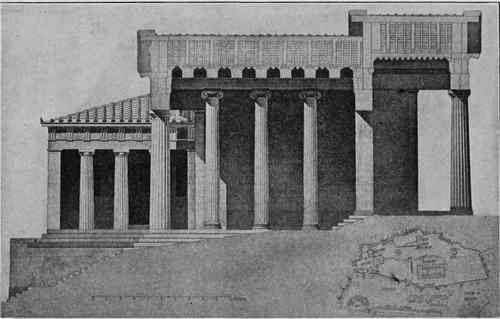
There is a third structure that was built a couple of decades later that utilizes the Doric and Ionic Orders: the Propylaea, which is the structure that provides the entrance onto the Acropolis. On the outside stands the Doric Order, but once under the canopy the columns become Ionic, and on the other side on the Acropolis the columns are Doric again. There are two reasons for doing this: one, masculinity goes on the outside; and two, there is a change in elevation, so the Doric on the on top of the Acropolis is several feet above the Doric Order at the entrance (hence the two pediments when viewed in elevation) — the Ionics align with the upper Doric columns, thus providing a rather clever segue between the two elevations.

Propylaea longitudinal section (note the height variation)

Well, Pericles died in 429 BCE, and the ambition of a Doria-Ionic alliance began to deteriorate. Athens became increasingly dependent on the Ionians, and their architecture would continue to reflect a strong Ionian alliance with alienation towards to Dorians. As such, many Athenian building projects began to use the Ionic and Corinthian Orders without the Doric. Firstly, there is the Temple of Athena Nike, a purely Ionic temple, which is directly next to the Propylaea and figures prominently when entering the Acropolis. Then comes the Erechtheion, which seems to change everything.

The Erechtheion is primarily Ionic in style the exception of the Porch of the Maidens, which uses one of the most famous examples of Caryatids (columns sculpted like humans) — the Caryatids (as Vitruvius so named them) are not the first example of anthropomorphic columns: the Treasuries of Siphnos and Cnidus at Delphi also used Caryatids on their porticoes. What makes the Erechtheion the prime example of Athens' alienation from the rest of Doria and resting solely on their Ionian allies is the myth of Erechtheus that was weaved and perpetuated by Euripides in his play Ion (and probably as well as in a lost play of his, Erechtheus): Erechtheus was an actual king of Athens, and is mentioned in the Iliad, but became a mythic character, so much so that it is hard to differentiate between the actual king and his legendary self. Euripides wrote Ion around 414 BCE, and mythologizes how King Erechtheus fathered Ion, who would go on to colonize and build Ionia.

Erechtheion reconstruction

Plays and works of poetry were rarely written in ancient times without political motive, either by a king or the author trying to become favorable with the king (Vitruvius did this with Caesar Augustus, as is evident in the prefaces of De Architectura) — take for instance Virgil's The Aeneid, which mythologizes how Aeneas fled burning Troy, eventually ended up in Latinum, and Julius Caesar and Augustus were progeny of Aeneas, whose mother was Venus. It is highly probably that the Erechtheion and Ion are testaments to Athens' loss of alliance with the Dorians and an attempt to strength their relation to their Ionian friends; even if it meant mythologizing that the two nations were actually kin.

On the other hand we have the Dorians, who continued to use their robust Doric Order for sometime until after the death of Pericles, who then began to utilize the Corinthian in their interiors instead of the Ionic. This is probably a shunning of the Ionians who had over a century before hand surrendered like cowards to the Persians. The anatomy and proportions of the Corinthian Order should be indicative of this: according to Vitruvius the Corinthian is simply the Ionic column in which the Ionic capital has been removed and the taller Corinthian capital has been placed on top (note that at the Temple in Bassae the Corinthian column is slightly thinner than the Ionics, possibly to account for the slightly taller Corinthian proportions). In a way the Dorians simply removed those much hated Ionians' capital and replaced the capital with one of their own — they kept the fluted shaft and the Attic base, but used a feminine capital that was Dorian. Corinth is after all a Dorian city neighboring fairly close to Attica on the Peloponnesian Peninsula.

As to why that Order is called Corinthian is a bit of a mystery, as it was not developed in Corinth, but Arcadia. There are two possibilities: one, that the slender proportions and dainty ornament of the Order reminded the Greeks of a young girl (the anthropomorphic argument), and so they called it kore (κόρη), "maiden", which in turn came to refer to Corinth (root word: kore), a city known for its sacred prostitutes; the other reason being that the first Corinthian column, i.e. at Bassae, was of such intricate and delicate design that it was more than likely marble covered in bronze ornamentation (we don't know the exact properties of it because it was lost while in Zakynthos during the 1953 earthquake, all we have are 19th Century archaeology drawings) — the bronze ornamentation may have reminded the Dorians of Corinth, which was known for its beautiful and well-crafted bronze vessels. That's about all Corinth was known for: sacred prostitutes to Aphrodite and bronze works.

In a way, the use of the Corinthian instead of the Ionic could be seen not so much as a shunning of the Ionians, but as introducing the newly developed, pretty, leafy Corinthian column, and to avoid any racial or political overtones. At the same time it seems to have racial overtones.

Thus we find Dorian architecture in the late 5th Century through the late 4th Century BCE using the Corinthian instead of Ionic. The tholos (a round building) sanctuary of Asclepius at Epidauros (c. 360 BCE) used the Doric Order on the exterior peristyle and Corinthian on the interior peristyle (this use of the orders may have esoteric overtones). Similarly in Epidauros is the Temple of Artemis (c. 330 BCE), which also has a Doric portico and interior peristyle of Corinthian columns. Those are really the two major Dorian-Corinthian structures. For the most part the Dorians kept with their robust Doric columns.

Sanctuary of Asclepius at Epidauros

But even with the Dorian animosity towards Ionia, it seems that nearly two centuries after the Greco-Persian Wars that such animosity might have died down. On the other side of the Peloponnesian Peninsula in Olympia the tholos Philippeion utilizes the Ionic Order on the exterior peristyle and the Corinthian on the interior. But then again, even in Epidauros the Temple of Aphrodite (c. 320 BCE) uses the Ionic Order on the portico and a Corinthian peristyle on the interior.

It is really around this time that the Orders begin to be used more for aesthetics and possible esoteric-symbolic purposes (such as the anthropomorphic reason). It seems reasonable that after a few hundred years with these architectural styles that the ancient Greeks would begin to mythologize them and make esoteric-symbolic associations with them. This becomes evident with certain Corinthian monuments at Delphi, such as the acanthus column.

Whatever the case, it should be clear that the Orders did not always have esoteric associations, though those associations certainly must have existed, but were far more subtle than the racial associations with the Orders. These racial and political overtones with the Orders were used in the decades following the Greco-Persian Wars, and symbolized alliances, as well as alienation with certain Hellenic races. 

One thing is for certain, and that is that the great Greek Classical Era is significant architecturally for the refining, development, and experimental use of the Orders; but as can be seen, this experimentation was largely politically motivated, rather than aesthetic. We may not have those great architectural works such as the Parthenon, the Temple of Apollo at Bassae (a personal favorite of mine), the Erechtheion, the Sanctuary of Asclepius at Epidauros, the Athenian Stoa at Delphi, the Propylaea, and the likes — at least not as we known them today — were it not for such racial and political tension that occurred in Greece during the aftermath of the Greco-Persian War.

Further reading:
Herodotus. The Histories.
Thucydides. The History of the Peloponnesian War.
Pausanias. Description of Greece.
Onians, John. Bearers of Meaning. Princeton University Press. 1988. <<Refer to Chapter 1 for political and racial uses of the Orders>>
Rykwert, Joseph. The Dancing Column. The MIT Press. 1996.
Cooper, Frederick A. The Temple of Apollo at Bassai. Garland Publishing, Inc. 1978.

Tuesday, July 29, 2014

Death No More: Lovecraft and Donne


There are really only two significantly influential writers to H.P. Lovecraft: E.A. Poe and Lord Dunsany. Even Lovecraft admitted this himself in a letter to Elizabeth Toldridge (March 8th, 1929):
"Even when I break away, it is generally only through imitating something else! There are my 'Poe' pieces & my 'Dunsany' pieces—but alas—where are my Lovecraft pieces?"
Certainly there were other influences, but those were the two big ones. I would actually like to focus on minor influence to Lovecraft: John Donne. Donne didn't have that great of an impact on Lovecraft (it seems difficult to imagine how he could have), but one of Lovecraft's famous "poems" (for it is only two lines longs) certainly has some some Donnian influence:
That is not dead which can eternal lie,
And with strange aeons even death may die.
This poem was originally written in The Nameless City, but is reiterated again in The Call of Cthulhu. It is the "even death may die" portion that seems to resonate with Donne's Death be not Proud (I will write the whole thing — it's not a long poem):
Death be not proud, though some have calléd thee
Might and dreadfull, for, thou art not so,
For, those, who thou think'st, thou dost overthrow,
Die not, poore death, nor yet canst thou kill me.
From rest and sleepe, which but thy pictures be,
Much pleasure, then from thee, much more must flow,
And soonest our best men with thee doe goe,
Rest of their bones, and soules deliverie.
Thou art slave to Fate, Chance, kings, and desperate men,
And does with poyson, warre, and sicknesse dwell,
And poppie, or charmes can make up sleepe as well,
And better then thy stroake; why swell'st thou then;
One short sleepe past, wee wake eternally,
And death shall be no more; death, thou shalt die.
It is in particularly the last line that resonates with Lovecraft's couplet: "And death shall be no more; death thou shalt die" vs. "And with strange aeons even death may die." Interestingly neither author capitalizes the word death, which would indicated there is no metaphysical or supernatural tone in the usage of the word death: death is not some daemon or god incarnate such as Milton renders Death in Paradise Lost (though Donne does speak directly to death); death is just the end of life. So what Donne and Lovecraft are both saying is paradoxical: death can achieve death.

But die is another word used here: "death may die" and "thou shalt die." Dying is a something that is done, and death is both something that has been done and the effect of the doing. I'm mincing words and being pedantic here, but both Lovecraft and Donne are being either redundant (like Nietzsche's example of lightning strike: the "doing-doing") and paradoxical... Paradoxical because it would be absurd for an effect (i.e. death) to cause (i.e. dying) its own effect upon itself, being simultaneously the cause of itself, and effecting itself as its own cause (I know that is confusing... it took me a couple of minutes to think through how to write that). It would seem that the ending of the end of life is the nature of immortality ("That is not dead which can eternal lie"), so the question arises: is immortality a paradox? If it is redundant, then it would be just a silly play of words and inherently meaningless. But if it is a paradox we might as well accept what Cantor, Gödel, and Turing concluded: there will be paradoxes, and many of them, that are unsolvable and incomprehensible. I suppose we don't even understand death enough to ponder the implications of death being no more.

There is something almost terrifying and painful in our inability to understand both death and Donne's paradox of death's death. Perhaps this is why Lovecraft used "death may die."

There is, however, one subtle but important different between the two: Donne says "death, thou shalt die" and Lovecraft says "even death may die." Donne renders the death of death as imperative and inevitable — a commandment. Lovecraft renders it as something possible but not inevitable; it can happen, but it does not have to happen.

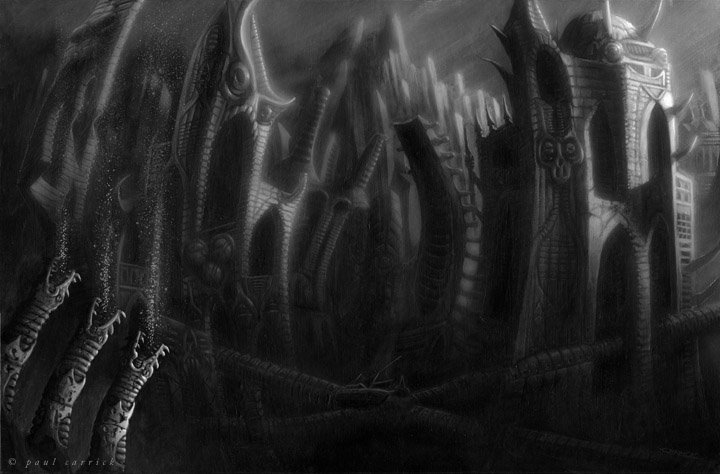
In reality what either author means is, admittedly, perplexing, though Donne is far more transparent than Lovecraft (and that only by comparison). Donne is essentially trash-talking death, calling death a slave that must obey fate and chance (note that Fate and Chance are made proper nouns by being capitalized in the poem). He is also saying to death that good men do not fear death, and that death is not unlike sleep: short and then we wake up (presumably in the afterlife: "One short sleepe past, wee wake eternally"). Death makes us sleep through its weapons of war, sickness, and poison, but we, too, induce sleep with drugs and charms — in a sense we possess the same powers as death. In short, Donne is saying that when we die we sleep for a short while and awake immortal; and by awaking eternally death will die. Lovecraft, however, does not give so much context as to his take on the death of death. In fact the poem is only given in those two short stories because the protagonist was reminded of the mad Arab, Abdul Alhazred, who wrote that couplet in his book The Necronomicon. But given the general content of Lovecraft's works we can conclude that he would be referring to ancient, immortal monsters that slumber ("eternal lie"). But then again, Lovecraft could  be saying that all things die, and all things must come to an end, so that after many "strange aeons even death may die." Like his monsters and aliens and ancient cities, Lovecraft is just as vague and haunting as he is with that couplet. Those two lines might be meant to drive the reader mad if one thinks about it for too long and in too much depth.

As to their exacting meaning and usage of death no more, it nonetheless seems reasonable to conclude that Lovecraft's "death may die" was inspired by Donne's Death be not Proud — the two poems are too strikingly similar (certainly Donald Burleson, Lovecraft: Disturbing the Universe, found the similarity between the two to be striking). It is difficult to imagine Lovecraft escaping grade school without ever having read some of Donne's work, even though he never finished high school. I personally discovered Death be not Proud and memorized it before I ever had to read it in high school.

And though the influence and inspiration of Donne and other authors (these other authors I will discuss in other posts down the way) upon Lovecraft do not readily jump off the page like Poe and Lord Dunsany do, it is nevertheless refreshing to take a look at other authors that inspired one of the great masters of horror.

Further reading:
Burleson, Donald R. Lovecraft: Disturbing the Universe. University Press of Kentucky. 1990. 

Monday, July 28, 2014

Faust: Thomas Mann and Nietzsche


I suppose for my first entry in this new found blog I will discuss and analyze a tale that is dear to my heart, and that has fascinated me for years: Faust.

Certainly Goethe's Faust is the most famous of the Faust tellings, though in too many ways Goethe's Faust is more like Job (for this is true) than like the Antichrist. It was Marlow who rendered Faust as the Antichrist — very literally his Doctor Faust lived a life that was the exact opposite of Christ's. Certainly Thomas Mann was cognizant of this; which leads me to what I consider the greatest of the Faust legends: Thomas Mann's Doktor Faustus.

Mann's Faust, a musician named Adrian Leverkühn, is modeled primarily off of the philosopher Friedrich Nietzsche. This is one reason for why I personally hold Mann's Doktor Faustus in a higher esteem than other tellings of Faust, for his melding of Faust with Nietzsche is not only well executed, but very clever. In addition to this, Mann's Doktor Faustus is very elegant in how he uses the tale of Faust to describe the state of the German people during World War II, i.e. Germany selling its soul to Hitler (Mann being an Exilliteratur writer — a German writer who fled Nazi Germany and dissented against the Nazi regime in his writings; as he was writing Doktor Faustus in the latter years of WWII and a few years past it).

But I wish to speak of Mann's very clever amalgamation of Nietzsche with Faust, for it is not only subtle, but well executed. There are, of course, all the obvious similarities: both Leverkühn and Nietzsche had fathers that died while they were still young; both studied theology and abandoned it to study with a professor in Leipzig (Nietzsche philology; Leverkühn music, though Nietzsche was also a music-lover and composer); both suffered life-long illnesses, headaches, nausea, eye soreness, et cetera; both contracted syphilis after they "accidentally" visited a brothel; both went mad and lived an additional eleven years under the care of each's sister; et cetera.

Beyond that there is his treatment of various character's names; names that are neither directly from the various Faust tales nor the life of Nietzsche, but oftentimes a strange combination of both, an etymological play, or derived and altered from a prominent German. Adrian's last name, Leverkühn, is a play on the German leben kühn, or "live boldly/dangerously" (a sort of motto of Nietzsche's). A very interesting use of name and character is Mann's use of Wagner, or lack there of. Richard Wagner was a mentor and father-figure to Nietzsche for some years; but Wagner is also the name of Faust's assistant; thus the two Wagners would be contradictory in their roles to each other. This is where I think Mann fails in some regards... how perfect it would have been to find a means to meld the two characters who also share the same name — unfortunately, there really is no character that is either like Richard Wagner or like Faust's assistant. I suspect Mann denounced Wagner as much a Nietzsche later did (I'm conjecturing), for Wagner was Antisemitic and a prototype for Hitler, and Mann and Nietzsche both regarded themselves as anti-Antisemitic. Mann even excludes a very large and influential portion of what would have been Nietzsche's life in Tribschen, where Nietzsche spent much of his time with the composer and his wife (I mean Wagner's wife, as Nietzsche never married... which brings me to Lou Salomé).

Serving two masters is something addressed in both Marlow and Goethe's Faust tales: since Faust has signed his soul to the Devil, he may not marry, for marriage is a covenant between two people under God; thus serving two masters. This is why Faust asks for Helen of Troy to be his consort and whore in Marlow's telling, and Gretchen is killed in Goethe's tale. Likewise, Adrian seeks to marry a woman, Ines Rodde, who is based on Lou Salomé. Adrian asks a friend to convey his wish to marry Ines, but Ines instead marries the messenger. Lou Salomé said that Nietzsche had asked her to marry him through his friend, Paul Rée, the psychologist, which she declined; she also claimed that Rée had also asked for her hand in marriage and also declined. Binion actually demonstrates that this was a lie Salomé told, for she desired both men, though neither ever actually asked her. Mann, however, would not have been aware of this, as he held Bertram's biography on Nietzsche above all others, and Bertram does relate Salomé's telling of Nietzsche's proposal to her. Nonetheless, it seems acceptable for Mann to use this falsehood for the sake of conveying the forbidden "serving two masters".

The last real comparison and analysis that is very well executed is the Antichrist theme. Nietzsche often referred to himself as "The Antichrist", as well as it was the title of the first part of an unfinished book; he also called himself an "Immoralist" and denounced all notions of good and evil and Judaic-Christian morality. So was Faust an Antichrist, living the exact opposite of the life of Christ: Christ was tempted by the Devil and declined, where Faust was tempted and accepted; Christ had wine with his closest friends (the Apostles) on his last night, as did Faust; but Christ did not wish to be alone and wanted someone to watch over him while he prayed, while Faust wanted to be alone and told his friends to go to bed and not worry about a thing; Christ went to Heaven and Faust went to Hell. Adrian Leverkühn does the same thing, gathering his friends for one last supper to drink wine, and told them he told he sold his soul to the Devil; then he collapsed and went insane. The parallel between Nietzsche and Leverkühn that I most enjoy is their last works: Nietzsche's last publication was called Ecce Homo ("This is the Man", a reference to John XIX:5 when Pontius Pilate presents Jesus to the Jews for execution), his autobiography. Clearly Nietzsche is continuing his Antichrist theme by mockingly identifying himself as Christ — he was known for calling himself Dionysus, especially when signing letters. Likewise, Adrian's last musical composition was called The Lamentation of Doctor Faust, clearly carrying on the Antichrist theme and referencing himself as a Faustian man; in other words, an autobiography.

I would not be the first to say that Nietzsche was a man of extraordinary character. He was regularly sick, "...uninterrupted three-day headache accompanied by the laborious vomiting of phlegm... No one has ever been able to diagnose fever in me" (EH §1), and yet he went on to write five books in six months, a couple of which were penned in just a couple of weeks. He certainly was of such physically weak but mentally stern character that it seems to be no wonder at all that Mann would find Nietzsche be of such extraordinary character that the man seemed to belong more in the realm of fiction than reality.

Certainly there is more to Mann's Doktor Faustus than these few simple things: it is a critique of art, music, psychology, the state and mind of the German people, the German spirit, what it is to be German, and some more stuff about Germany. Of course one could filter the work through Mann's Exilliteratur spirit and a criticism of Germany selling its soul to Hitler, something William McDonald addresses several times in his Thomas Mann's Joseph and His Brothers. But this and what I have written is an aspect of Mann's telling of Faust that I do not think gets enough admiration.

Further reading:
Mann, Thomas. Doctor Faustus: The Life of the German Composer Adrian Leverkühn, as Told by a  Friend. Knopf, Inc. 1948.
Kaufmann, Walter. Nietzsche: Philosopher, Psychologist, Antichrist. Princeton University Press. 1950.
Nietzsche, Friedrich. Ecce Homo: How One Becomes What One Is. 1908.

Sunday, July 27, 2014

In The Beginning...


An introduction to a new found blog:

After a long personal debate with myself I have decided to start a new blog. My old one, Perceptions In Chronomorphosis, just wasn't doing it for me anymore. I really had no idea what I wanted to do with it when I first began writing in that blog — I had no theme in mind, much less did I know what to name it (hence the very pretentious title). It began with science and religion, then moved into politics, then general themes (e.g. masks, fear), and occasionally interspersed with posts on art and architecture. It having no real direction when it began, and thereafter gaining no real direction for the future, I have decided to quit the ghost on that blog and begin anew. In looking back on what I wrote in that blog over the course of four year I find much of what I wrote detestable with the occasional good idea — it reeks of an amateur polymath questioning a silence universe. So enough! I wish to begin again.

This blog, however, does have a direction: simply my thoughts, critique, and analysis of various artists and thinkers and their works. I will not present any new ideas or philosophies, but simply reflect on what others have written, filmed, painted, sculpted, and composed. This is not meant to be a pure criticism, for I loathe critics. I believe Mark Twain said it best: "The critic's symbol should be the tumble-bug: he deposits his egg in somebody else's dung, otherwise he could not hatch it." No, this is also meant to be analysis and exploration of philosophies, themes, symbols, and concepts.

I suspect, knowing myself, that there will not be much of a theme or format, for I may easily jump from an excerpt of poetry from E. A. Poe in one post to the ideals of architecture according to Bramante in another, then to the literary influences of Jules Verne in another. This will be the various analyses of ideas and themes and symbols in whatever is captivating my mind at the moment. I imagine that my own personal thoughts and sentiments will be interpolated from time to time. Whatever.

And so now it begins.